8 Software Engineer Recruiter Questions to Ask
Prepare for software engineer recruiter questions with example answers, evaluation tips, and smart questions candidates should ask hiring teams.

Are recruiter screens really just résumé checks? If that's all a hiring team is doing, it's missing the most useful signal available before the technical loop. Strong software engineer recruiter questions reveal how a candidate takes ownership, makes trade-offs, communicates under uncertainty, learns from mistakes, and works with other engineers.
The historical hiring pipeline explains why this conversation matters. A widely cited technical-interview study describes a process that starts with a phone or online screen, moves into remote or on-site technical interviews, and ends with an offer to qualified candidates. The recruiter screen is the front door to a multi-stage evaluation system, not a standalone conversation. The IEEE-referenced interview study shows why early questions should filter for ownership, project scope, debugging judgment, system complexity, and collaboration before expensive engineering rounds begin.
The questions below help candidates prepare credible, specific answers. They also help hiring managers evaluate evidence instead of polished claims. Senior candidates should use the same conversation to test role scope, decision-making, technical standards, and team conditions.
Table of Contents
1. Tell Me About Your Most Complex Technical Project - What to listen for
2. Walk Me Through Your Debugging Process - The evidence behind a reliable process
3. How Would You Approach Optimizing a Slow System You Didn't Write? - Measure before changing
4. Describe a Time You Had to Work With Unclear Requirements - Strong answers make uncertainty visible
5. Tell Me About a Technical Decision You Regret and What You Learned - Separate reflection from blame
6. Tell Me About a Time You Influenced a Technical Decision You Initially Disagreed With - Listen for flexibility without passivity
7. How Do You Approach Code Review? What Do You Look For? - Review quality is team quality
8. How Do You Stay Current With Evolving Technology? - Look for judgment, not trend consumption
9. How Should Candidates Evaluate the Role and Hiring Team? - Hiring teams should answer with substance
9-Question Comparison for Software Engineer Recruiters
Turn Better Questions Into Better Engineering Hires
1. Tell Me About Your Most Complex Technical Project
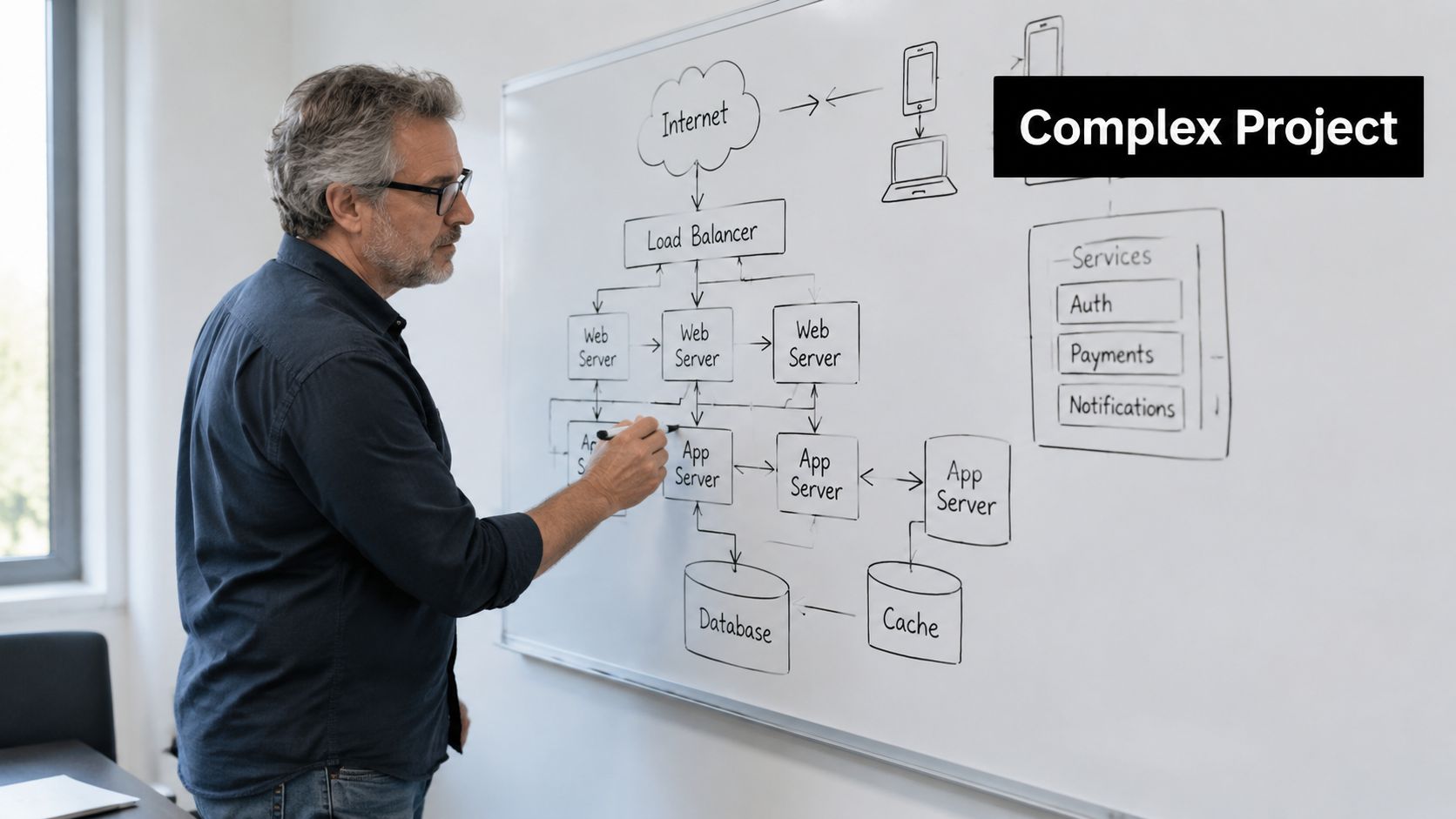
This question opens the door to technical depth without forcing a candidate into a rehearsed algorithm exercise. A strong answer explains what the system did, what the candidate personally owned, which constraints shaped the design, and how the team knew the work succeeded.
Listen for decisions, not a list of technologies. A backend engineer might describe decomposing a monolith into services, then explain why the team chose a particular boundary, how it handled data consistency, and what operational burden the migration created. A DevOps engineer might discuss infrastructure as code across cloud environments, including deployment safety, observability, and rollback planning. An AI engineer should be able to explain the data pipeline, evaluation method, model-serving constraints, and failure modes, not name a framework.
What to listen for
Specific ownership: Can the candidate separate their decisions from the team's broader work?
Trade-off awareness: Do they explain what the design sacrificed, such as simplicity for scale or delivery speed for flexibility?
Operational thinking: Do they mention testing, monitoring, incidents, maintenance, or deployment?
Relevant complexity: Does the project resemble the role's systems, users, reliability needs, or engineering constraints?
A useful senior-level follow-up is, “What would you design differently today, and what evidence would change your mind?” That question tests reflection rather than hindsight theater. It also connects naturally to engineering problem-solving practices, especially the difference between naming a problem and showing a repeatable way to solve it.
Practical rule: Treat “we built” as a prompt for clarification, not proof of individual ownership.
The candidate should also ask, “Which part of the role involves this level of technical ownership?” That turns the interview into a two-way evaluation and helps determine whether the opportunity offers architecture responsibility or mainly implementation within an existing design.
2. Walk Me Through Your Debugging Process
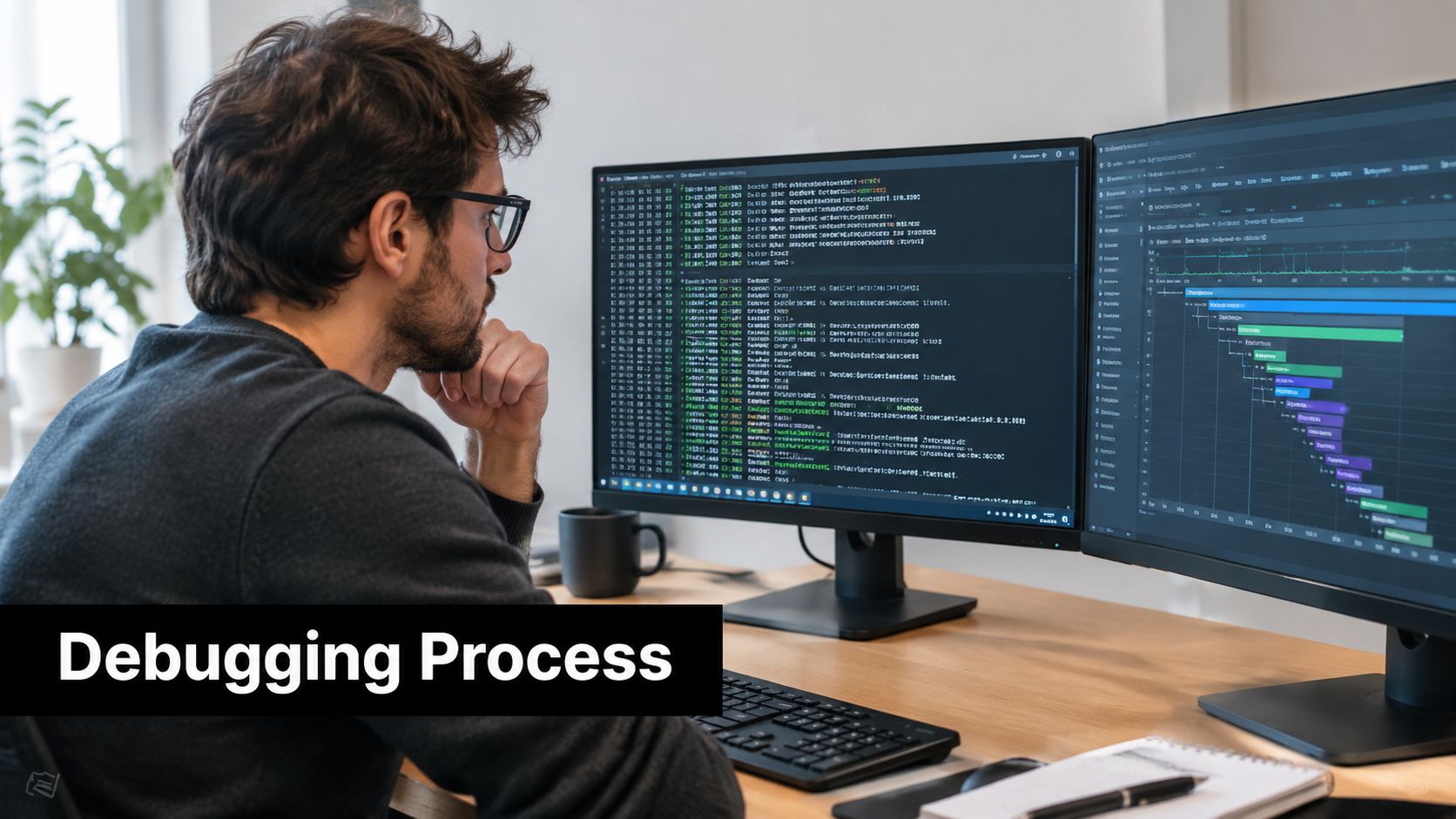
Debugging questions reveal how an engineer behaves when the answer isn't obvious. The strongest candidates don't jump straight to a fix. They establish impact, gather evidence, narrow the search space, form hypotheses, test them, and communicate while the issue remains unresolved.
A real example is more valuable than a theoretical workflow. A backend engineer might describe using distributed tracing to isolate a slow database call. A full-stack engineer could explain how browser DevTools, network inspection, server logs, and request correlation helped distinguish a client defect from an API problem. A platform engineer should be comfortable discussing the boundary between application behavior, infrastructure saturation, configuration drift, and dependency failure.
The evidence behind a reliable process
Look for a sequence that includes:
Scope definition: The candidate identifies who is affected and whether the issue is reproducible.
Data collection: They inspect logs, metrics, traces, recent changes, and relevant system state before editing code.
Controlled action: They isolate variables, reproduce safely, and avoid making several unmeasured changes at once.
Learning afterward: They add tests, alerts, documentation, or process changes that reduce recurrence.
A 45 to 60-minute technical phone screen commonly uses a shared editor and one or two coding problems to assess coding ability alongside communication, according to this overview of software engineering interview structure. A recruiter screen doesn't need to reproduce that format. It should establish whether the candidate can explain technical reasoning clearly enough for the later interviewers to evaluate it.
Ask a senior candidate, “How would you lead the investigation if your first hypothesis were wrong and the incident were still affecting customers?” The answer should show prioritization, delegation, incident communication, and willingness to revise assumptions.
A candidate can ask, “How does this team handle incidents, and what happens after service is restored?” The response reveals whether the company values learning or merely expects engineers to absorb recurring operational pain.
3. How Would You Approach Optimizing a Slow System You Didn't Write?
This scenario tests whether the engineer respects evidence and existing systems. Candidates who immediately propose rewriting the service may have strong instincts about clean architecture, but they haven't yet shown that they can diagnose the actual bottleneck.
A credible answer starts with the user-visible symptom and the relevant service-level objective. From there, the engineer should identify whether the constraint is CPU, memory, I/O, network behavior, database access, lock contention, inefficient algorithms, or an external dependency. Useful tools might include an APM platform, flame graphs, database query plans, runtime profilers, browser performance tools, and infrastructure metrics.
Measure before changing
Ask the candidate to explain how they'd compare a suspected bottleneck with observed production behavior. A backend engineer should discuss query analysis and request traces. A cloud engineer might examine resource utilization and usage patterns before right-sizing instances. A front-end engineer could use browser profiling to separate rendering cost from network delay. A platform engineer should consider capacity, noisy neighbors, scheduling, and saturation.
The question also exposes prioritization. An engineer who understands performance will distinguish an urgent customer-facing latency issue from a low-impact optimization that merely improves an internal benchmark. They'll consider rollback, canary deployment, regression testing, and the risk that a local improvement shifts pressure elsewhere.
The database performance tuning guide is relevant when the candidate's example involves query plans, indexes, connection pools, or data access patterns. Don't reward tool name-dropping. Ask what signal each tool provides and what decision it enables.
“What would make you stop optimizing and choose a larger architectural change?”
That senior-level follow-up tests judgment about diminishing returns. A candidate should be able to explain when a targeted fix is safer and when the current design prevents meaningful improvement.
Candidates should ask, “Which performance problems are most important for this team today, and how are they measured?” That answer clarifies whether the company has meaningful observability or expects engineers to optimize by intuition.
4. Describe a Time You Had to Work With Unclear Requirements
Ambiguity is normal in engineering. The useful distinction is whether a candidate makes assumptions or turns uncertainty into an explicit decision process.
Listen for a story with active clarification. A product engineer might have created a lightweight workflow or wireframe before implementation and used stakeholder feedback to confirm expected behavior. A data engineer should clarify business definitions, data quality expectations, freshness, and ownership. An AI engineer may need to establish success metrics, acceptable error modes, training-data requirements, and how the product team will use model output.
Strong answers make uncertainty visible
A candidate's clarifying questions matter more than the phrase “I communicated with stakeholders.” Look for questions about:
Users and outcomes: Who needs the capability, and what decision or workflow should it support?
Functional behavior: What must the system do under normal and exceptional conditions?
Nonfunctional expectations: What matters about reliability, latency, security, scale, or maintainability?
Decision ownership: Who can resolve disagreements when requirements conflict?
Engineers often discover that a requirement is incomplete only after code ships. Ask, “What assumption created the most risk, and how did you surface it?” The answer shows whether the candidate documents decisions, uses acceptance criteria, prototypes uncertain areas, and creates feedback loops before rework becomes expensive.
A helpful reference for assessing the difference between behavior and system constraints is this explanation of functional and nonfunctional requirements. It gives recruiters a practical vocabulary for probing beyond “the requirements changed.”

The candidate's question should be, “How does this team turn ambiguous product goals into engineering decisions?” A mature hiring team can explain who participates, where decisions are recorded, and how scope changes are handled.
5. Tell Me About a Technical Decision You Regret and What You Learned
A polished résumé shows outcomes. This question shows whether the engineer can examine a decision that didn't age well.
The answer doesn't need to involve a dramatic production failure. A candidate might have optimized before profiling, selected an abstraction that slowed delivery, introduced unnecessary architectural complexity, or delayed logging until an incident exposed the gap. The important evidence is specificity. What did they believe at the time? What information did they have? What happened? Which part of their decision process changed afterward?
Separate reflection from blame
Weak answers shift responsibility to an unreasonable manager, a vague “business decision,” or an unnamed teammate. Strong answers acknowledge constraints while still identifying personal judgment. The engineer can say a decision made sense under a deadline and still explain why the team should have documented the risk, measured the result, or created a reversal point.
Ask, “What process now prevents you from repeating that mistake?” The answer should produce a concrete practice, such as profiling before optimizing, validating a design with a smaller experiment, adding operational readiness criteria, or seeking review from someone with relevant production experience.
For senior candidates, follow with, “How did you communicate the mistake to the team?” Leaders don't only learn privately. They help others understand the failure without creating a blame culture.
Candidates should ask, “How does this organization handle technical debt and decisions that turn out to be wrong?” That response can reveal whether engineers are allowed to surface risks, revisit architecture, and learn from incidents, or whether the culture rewards confident delivery even when evidence changes.
6. Tell Me About a Time You Influenced a Technical Decision You Initially Disagreed With
Technical influence isn't the same as winning an argument. This question tests whether an engineer can understand another position, present evidence, adapt the proposal, and support a decision once the group chooses a direction.
A useful example might involve a disagreement about a programming language, deployment framework, testing standard, data model, or service boundary. Listen for how the candidate built trust. Did they write a design proposal? Run a small experiment? Compare operational costs? Ask the team to define decision criteria? The method matters because senior engineers often influence decisions without formal authority.
Listen for flexibility without passivity
A candidate who says, “I proved everyone wrong,” may have technical confidence but weak collaboration instincts. A candidate who says, “I stopped raising the issue,” may avoid conflict rather than resolve it. Better answers show respectful disagreement and a clear point at which the engineer either changed their mind or committed to the team's decision.
Ask, “What changed your view?” That follow-up makes it difficult to deliver a one-sided story. The response should identify new evidence, a previously misunderstood constraint, or a better interpretation of the team's goals.
A second senior-level follow-up is, “How did you help the team execute after the decision?” Strong collaborators don't continue undermining a choice after the meeting. They document remaining risks, define review points, and help the implementation succeed.
Candidates should ask, “Who makes the final call on architecture here, and how are dissenting views recorded?” This reveals whether the team has a real decision process or relies on the loudest voice in the room.
7. How Do You Approach Code Review? What Do You Look For?
Code review reveals technical standards and interpersonal judgment at the same time. The strongest engineers focus first on correctness, security, architecture, maintainability, failure modes, and test coverage. They don't spend the review treating formatting preferences as if they were production risks.
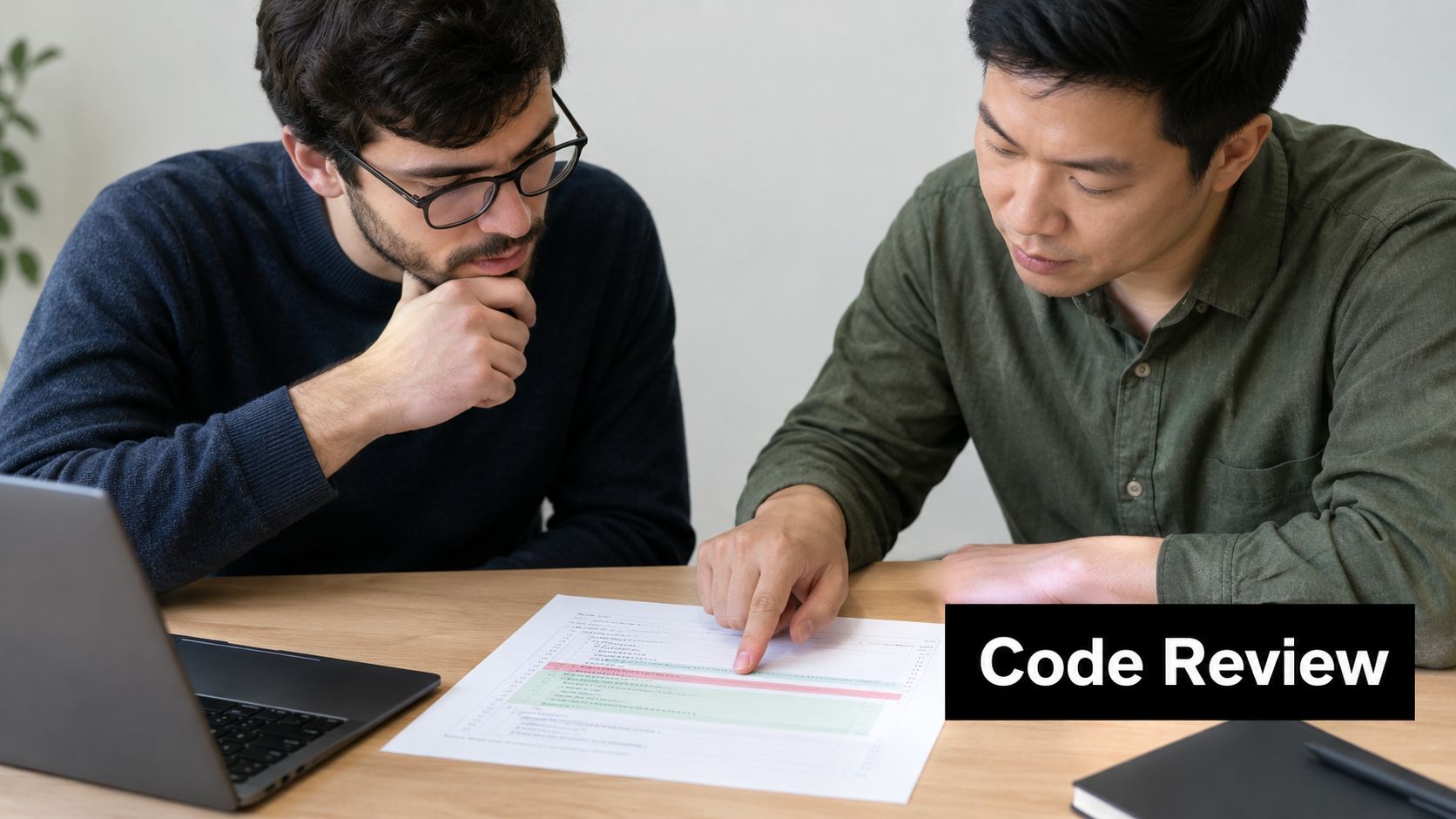
Ask the candidate to describe a difficult review they handled recently. A good answer explains how they separated blocking concerns from suggestions, used examples instead of personal preferences, and kept the discussion focused on the code. An infrastructure engineer should consider security exposure, scaling behavior, and operational recovery in infrastructure-as-code. A data engineer should inspect pipeline correctness, data quality, lineage, and performance. An AI engineer should examine data handling, model validity, evaluation gaps, and deployment behavior.
Review quality is team quality
Listen for balance. An engineer who approves everything may be easy to work with but unreliable as a quality partner. An engineer who blocks every change over idealized standards can slow delivery and discourage collaboration. Mature reviewers explain risk, propose options, and know when a concern belongs in a follow-up issue rather than the current change.
Ask, “How do you handle a disagreement when the author doesn't accept your feedback?” A senior candidate should mention clarifying intent, discussing the concern synchronously when needed, involving the appropriate owner, and accepting a decision once the risk is understood.
The broader interview process consistently emphasizes code quality, debugging, technical fundamentals, and collaboration, as summarized in this software engineer interview question guide. That makes code review a useful recruiter-screen topic, especially for roles where engineers shape standards for others.
Candidates should ask, “What makes a pull request ready for review here, and how quickly does feedback usually arrive?” The answer exposes workflow health, reviewer availability, ownership clarity, and whether review is a learning mechanism or a queue that delays delivery.
8. How Do You Stay Current With Evolving Technology?
A strong engineer doesn't chase every new framework. They build a method for deciding what deserves attention and then test ideas against real constraints.
Ask for a recent example. The candidate might have studied a new cloud service, built a small prototype, contributed to an open-source project, followed technical documentation, joined a community, or introduced a tool after validating its fit. Specificity matters. “I keep up with technology” says little. “I evaluated a new deployment approach against our rollback and observability requirements, then documented why we did not adopt it” says much more.
Look for judgment, not trend consumption
Useful signals include:
Structured learning: The engineer uses courses, documentation, books, or technical talks to build foundations.
Applied experimentation: They test ideas in side projects, prototypes, internal tools, or production-safe trials.
Selection criteria: They evaluate maturity, maintenance burden, team capability, security, compatibility, and business value.
Knowledge sharing: They write documentation, present findings, mentor teammates, or contribute improvements.
For AI-focused roles, ask how the candidate validates information from AI coding tools and how they protect code quality, security, and ownership. Recent coverage argues that live signal matters more as take-home work and asynchronous tests can be completed invisibly with AI, while reporting that more than 90% of developers in Western markets use AI coding tools daily. This discussion of software engineering interview questions and AI-assisted interviewing supports a more nuanced question: not whether someone uses AI, but how they verify its outputs and recognize its limits.
Candidates should ask, “How does the team create time for technical learning, and which technology decisions will this role influence?” That distinguishes a role with genuine engineering growth from one that only advertises innovation.
9. How Should Candidates Evaluate the Role and Hiring Team?
The best recruiter screen gives candidates enough information to decide whether the role deserves continued investment. Candidates should ask what the team needs solved first, how technical decisions are made, who owns architecture trade-offs, how engineers collaborate, and what success looks like early in the role.
A senior engineer might ask, “Which decisions will I own independently, and which require approval?” Another useful question is, “How are disagreements resolved when product urgency conflicts with reliability or maintainability?” Candidates can also ask about reporting lines, interview stages, on-call expectations, deployment practices, and the team's approach to technical debt.
Hiring teams should answer with substance
Recruiters and hiring managers need a clear intake before they evaluate candidates. That includes the role's mission, stack, environment, first-stage expectations, must-haves, trade-offs, screening depth, evidence of fit, search strategy, and calibration process. A candidate experience built around vague answers creates the same risk as a vague technical requirement. This candidate experience guidance explains why clarity and communication shape the quality of the hiring process.
The scale of the market makes signal discipline important. Independent hiring coverage describes situations with 1,000 or more applications for one role, along with increased use of upfront barriers, AI filtering, and trial work. The State of the Tech Market in 2025 frames the challenge as filtering for authenticity and readiness, not processing more résumés.
Staffing models should match the problem. Direct hire suits permanent team building. Staff augmentation adds specialized contractors around an existing team. On-demand provides access to a pre-vetted bench, while managed services place delivery responsibility with an external engineering team. TekRecruiter supports technology staffing and recruiting across software, AI, DevOps, cloud, data, Salesforce, ERP, and cybersecurity engineering. Candidates and hiring managers can also use the best hiring email templates for 2026 to keep communication clear throughout the process.
9-Question Comparison for Software Engineer Recruiters
Question | 🔄 Implementation Complexity | ⚡ Resource & Time | ⭐ Expected Effectiveness | 📊 Expected Impact | 💡 Key Tips |
|---|---|---|---|---|---|
Tell Me About Your Most Complex Technical Project | Medium, open-ended; requires skilled probing | Low candidate prep; moderate interviewer time | ⭐⭐⭐⭐, strong signal of seniority | Reveals architecture decisions, trade-offs, real-world experience | Ask for specific decisions, role ownership, and follow-ups |
Walk Me Through Your Debugging Process | Medium, structured methodology assessment | Low interviewer prep; may require follow-up scenarios | ⭐⭐⭐⭐, predictive of incident performance | Shows troubleshooting rigor, tool familiarity, reliability under pressure | Request a recent example, tools used, and data‑first steps |
How Would You Approach Optimizing a Slow System You Didn't Write? | High, requires system and profiling knowledge | Moderate, candidate should reference tools and metrics | ⭐⭐⭐⭐, practical test of performance skills | Reveals profiling capability, risk awareness, and prioritization | Listen for "measure before change" and specific profiling tools |
Describe a Time You Had to Work With Unclear Requirements | Low–Medium, focuses on communication and judgment | Low, behavioral answer; interviewer evaluates nuance | ⭐⭐⭐⭐, strong indicator of stakeholder skills | Shows ability to reduce ambiguity, document assumptions, prevent rework | Probe clarifying questions asked and how assumptions were recorded |
Tell Me About a Technical Decision You Regret and What You Learned | Low, behavioral, introspective | Low, short anecdote; interviewer gauges authenticity | ⭐⭐⭐⭐, reveals growth mindset and accountability | Signals learning habits and likelihood to avoid repeat mistakes | Look for genuine reflection and concrete process changes adopted |
Tell Me About a Time You Influenced a Technical Decision You Initially Disagreed With | Medium, assesses influence and collaboration | Low, behavioral with evidence of outcome | ⭐⭐⭐⭐, predicts team fit and persuasion skills | Demonstrates negotiation, empathy, and consensus-building | Ask how they built trust, what arguments they used, and the outcome |
How Do You Approach Code Review? What Do You Look For? | Medium, combines technical and cultural criteria | Low–Moderate, may include examples of diffs or practices | ⭐⭐⭐⭐, signals impact on code quality and mentorship | Predicts long-term team standards, maintainability, and onboarding | Listen for balance between substance and style and conflict handling |
How Do You Stay Current With Evolving Technology? | Low, assesses learning habits | Low, candidate lists channels and recent examples | ⭐⭐⭐, indicative of growth potential over time | Shows adaptability and potential for future skill acquisition | Ask for recent technologies learned and how they share knowledge |
How Should Candidates Evaluate the Role and Hiring Team? | Low, meta-question for two-way assessment | Low, guides candidate and recruiter conversation | ⭐⭐⭐, improves alignment and candidate experience | Clarifies expectations, reduces mis-hires, informs recruiting strategy | Recommend asking about first priorities, decision ownership, and team dynamics |
Turn Better Questions Into Better Engineering Hires
Good recruiter questions don't try to simulate every technical interview. They identify whether a candidate has the experience, reasoning habits, and communication style needed to make the later rounds meaningful. The strongest answers show ownership, not just participation. They include evidence, explain constraints, acknowledge trade-offs, and connect technical decisions to users, operations, teammates, or business outcomes.
The questions also need to match the way software engineers are evaluated. A 2026 interview-question dataset lists 2,822 coding and algorithms questions, 1,114 system-design questions, 630 behavioral and leadership questions, and 548 software-engineering fundamentals questions. The dataset and category breakdown show that technical problem-solving remains the largest part of the interview ecosystem, with system design following behind. Recruiter screens shouldn't attempt to replace those assessments, but they should surface the evidence that makes them worth scheduling.
That means asking about shipped systems, debugging, performance, ambiguity, mistakes, influence, code review, and learning. It also means probing with follow-ups that prevent broad claims from passing as proof. “What did you personally decide?” “What evidence did you use?” “What would you change now?” and “How did the team respond?” often produce more signal than another generic résumé walkthrough.
Hiring teams should apply the same standard to the role itself. A candidate who asks about ownership, architecture governance, success criteria, incident response, and collaboration isn't being difficult. They're testing whether the company has defined the conditions in which an engineer can succeed. Clear answers improve trust, calibration, and the chance of a productive match.
The cost of weak early screening is substantial. One industry report found that engineering leaders average 20.7 first-round technical interviews per software engineering hire, while digital businesses average 26.3. At 90 minutes per interview and write-up, the report estimates nearly 40 engineering hours spent on first-round technical interviews per hire, before later onsite rounds are included. The engineering interview workload report makes the business case for asking sharper recruiter questions before engineers spend time in technical loops.
Companies that need specialized talent can use TekRecruiter for technology staffing and recruiting and AI engineering support. Its engineer-to-engineer model uses deep technical conversations to connect companies with top-tier engineering talent anywhere, with options that include direct hire, staff augmentation, on-demand support, and managed services. Explore TekRecruiter when the role requires software, AI, DevOps, SRE, platform, cloud, data, Salesforce, ERP, or cybersecurity expertise that internal recruiting capacity can't reliably reach.
TekRecruiter provides technology staffing and recruiting, including AI engineering support, through an engineer-to-engineer process built around the signals discussed in this guide. Visit TekRecruiter to discuss direct hire, staff augmentation, on-demand, or managed services for your next specialized engineering role.