Staff Augmentation Contract: A Complete Guide
Learn how to structure a staff augmentation contract. This guide covers key clauses, pricing models, and compliance tips for hiring managers.


Most advice about a staff augmentation contract starts with the wrong premise. It treats the document as a procurement form that confirms the vendor's hourly rate, start date, and replacement policy. That view is convenient, but it misses where augmentation deals fail. The contract decides who controls the work, who employs the engineer, who owns the code, how scope changes, and whether your team can exit without losing operational knowledge.
The vendor's sales deck sells capable people. The agreement determines whether those people remain external, whether the relationship can scale across countries, and whether flexible capacity stays flexible. A useful contract is a risk-engineering document. It turns potential co-employment, scope creep, IP leakage, security exposure, and vendor lock-in into explicit operating rules.
Table of Contents
Why the Contract Matters More Than the Vendor
What a Staff Augmentation Contract Is
The Clauses That Decide Whether the Deal Works - Scope and service definition - Billing and pricing - IP assignment and repository rights - Confidentiality, security, and data protection - Termination and transition - Performance, liability, and insurance
Billing and Pricing Models Compared
How Augmentation Deals Silently Fail - The employment boundary also drifts
Negotiation Moves That Actually Shift the Terms - Start with the rate card - Trade price for protection - Challenge the liability cap - Protect the off-ramp - Freeze the commercial rules
CTO Checklist and How TekRecruiter Fits - Contract clauses - Commercial and operational controls - The three clauses people skip under pressure
Why the Contract Matters More Than the Vendor
A strong engineer can still end up inside a weak engagement. The failure usually isn't talent. It's an agreement that leaves critical decisions to assumption, informal Slack messages, or a generic master services agreement copied from another type of procurement.
Staff augmentation has become a mainstream workforce mechanism. The Bureau of Labor Statistics tracks temporary help as a distinct employment category, and market reporting shows temporary help services rising from 2,451,400 jobs in December 2025 to 2,505,000 in July 2026, a net gain of 53,600 jobs during that period. The same reporting compares temporary help services with computer systems design services, which remained around 2.37 million jobs, while temporary help stayed above 2.5 million. That scale shows why the legal and operating details matter. This isn't a niche workaround for one urgent project. It's a major way employers add capacity without permanently expanding payroll. (BLS temporary-help market context)
Before you compare vendors, define the contract questions that procurement teams often skim:
Employment boundary: Who handles payroll, taxes, benefits, classification, and HR administration?
Technical control: Who sets priorities, reviews code, controls repository permissions, and approves output?
Economic control: What counts as billable time, and what can change the rate?
Ownership: Does your company receive the code, documentation, models, prompts, and architecture produced for it?
Exit: Can you remove one resource, demand a handoff, or terminate for convenience?
Practical rule: If a clause affects control, ownership, cost, or exit, it belongs in the negotiation. Don't let a standard MSA decide it by omission.
Use a deliberate vendor selection criteria framework before the contract reaches legal. The vendor with the strongest technical bench isn't automatically the vendor with the safest operating model. Your legal team should review the agreement alongside the staffing plan, access model, reporting structure, and delivery expectations. That's how you find the gaps before the first engineer joins the sprint.
What a Staff Augmentation Contract Is
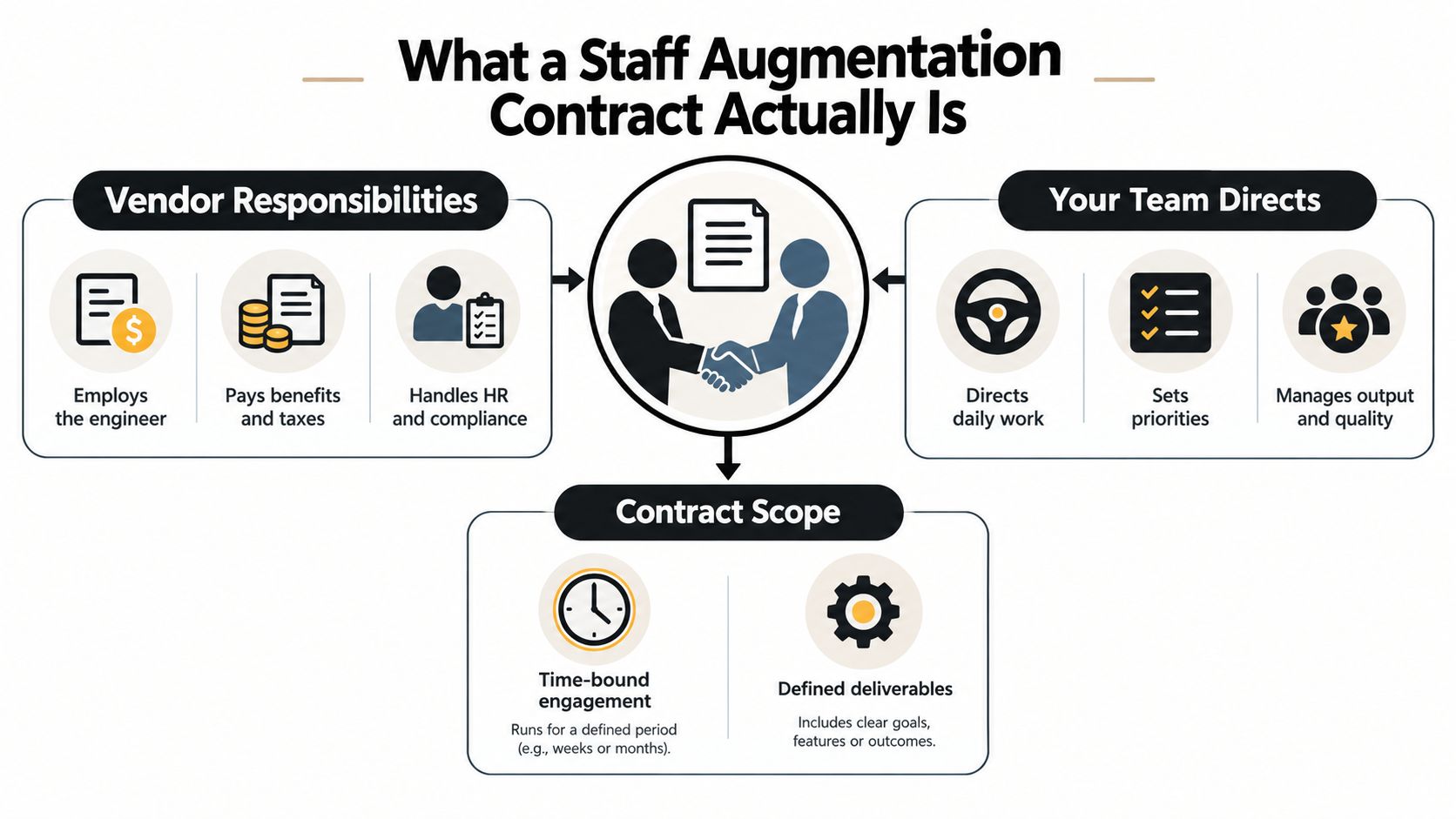
A staff augmentation contract is a risk-engineering document, not a procurement formality. It defines who employs the engineer, who directs the work, who owns the output, and what happens when the engagement changes or ends.
The staffing provider should remain the employer of record. It pays wages and benefits, manages payroll and taxes, and handles HR administration. Your engineering organization assigns backlog work, sets technical priorities, conducts code reviews, and decides whether the output meets your standards. Keep those responsibilities explicit. Blurred authority creates co-employment exposure and makes accountability difficult.
The contract must separate employment administration from technical control. It should state who controls scheduling, security access, performance feedback, resource replacement, and HR matters. The allocation needs to match daily practice, not just the wording on the page. The ThirstySprout guide for engineering leaders offers a useful comparison between embedded engineers and broader delivery models.
The operating models differ in who owns delivery:
Staff augmentation: Your managers direct individual engineers within your workflow. Your company makes product decisions and generally pays for time worked.
Outsourcing: The provider takes responsibility for a broader function or project, usually with its own methods and management structure.
Managed services: The provider owns defined operational outcomes, service levels, escalation, and performance management.
Augmentation removes employment overhead, not engineering management. Your team still owns priorities, quality standards, and product decisions. The provider remains responsible for its employment obligations and should support replacement and HR processes without taking over your technical organization.
Before redlining, review this staff augmentation services overview to clarify how the operating model differs from outsourcing and managed services. Then make the agreement govern the scope of services, duration, rate card, billing rules, replacement, IP assignment, confidentiality, data protection, liability, insurance, and exit. If any of those terms remain vague, the team will invent working rules after kickoff.
The Clauses That Decide Whether the Deal Works
The contract needs more than a job title and an hourly rate. It needs a governance layer that tells both sides how the engagement behaves when priorities change, a resource leaves, or production data becomes involved.
Scope and service definition
The SOW should identify the role, seniority, relevant technology, expected availability, time-zone overlap, reporting line, and intended workstream. It should also distinguish a flexible backlog from commitments that require defined acceptance criteria.
Vendors often resist detailed role language because it narrows their ability to substitute resources. That's precisely why you need it. A named senior engineer shouldn't become a junior replacement with the same rate.
Billing and pricing
Specify the rate card, billing unit, approved working hours, overtime rules, holidays, expenses, currency, invoice timing, and any rate-adjustment mechanism. State what requires written approval. A vague “additional services” clause is an invitation to argue later.
The provider may push for unilateral rate changes or minimum billable hours. Ask for advance notice, a defined trigger, and the right to reduce or terminate affected resources if the price changes.
IP assignment and repository rights
Your agreement should assign work product to your company, address work-for-hire treatment where applicable, and separate vendor pre-existing IP from newly created deliverables. It should cover source code, documentation, architecture, infrastructure definitions, test assets, AI-generated output, prompts, evaluation artifacts, and technical designs.
Vendors commonly request broad rights to reuse “generic know-how.” Accept a carefully defined carve-out for pre-existing tools, but don't allow it to swallow the work created for your product. Repository access and branch permissions should also be explicit. Ownership without practical access is a paper victory.
Confidentiality, security, and data protection
Confidentiality obligations should bind the provider and the individual engineer. Add access controls, security training, incident notification, data residency, subprocessors, deletion duties, audit evidence, and restrictions on using client data to train models.
Compliance language increasingly needs to address GDPR, AI governance, PCI DSS, HIPAA, SOC 2 evidence trails, and EU AI Act obligations, depending on the systems and jurisdictions involved. (Staff augmentation contract trends and AI-aware compliance) Vendors may call these requirements excessive. If their engineer touches regulated data, the requirements aren't excessive. They're the operating conditions.
Termination and transition
Require a clear notice period, termination for convenience, resource-level termination, replacement mechanics, and transition assistance. The SOW should survive a decision to remove one engineer without forcing you to end the entire MSA.
Knowledge transfer needs its own obligation. Require updated documentation, recorded walkthroughs where appropriate, open pull requests, credentials handoff through approved channels, and a defined transition schedule. Vendors often resist uncapped transition support. Set a reasonable included obligation, then define rates for additional assistance.
Performance, liability, and insurance
Use service levels for responsiveness, replacement, incident escalation, and communication rather than pretending an individual engineer can guarantee an entire product outcome. Add cure periods and a remedy if the provider fails to meet a material obligation.
Liability caps deserve more attention when the engineer has production, security, or regulated-data access. Negotiate carve-outs for confidentiality breaches, IP infringement, fraud, gross negligence, and security incidents where appropriate. Confirm professional liability, cyber coverage, workers' compensation, and employer obligations.
The following table is a useful negotiation filter:
Clause | What It Locks Down | Common Vendor Pushback |
|---|---|---|
Scope of work | Role, technology, duties, reporting, and boundaries | Flexibility to substitute or expand duties |
Billing and pricing | Rates, hours, overtime, currency, and changes | Minimum hours or unilateral increases |
IP assignment | Ownership of code, documentation, and technical work | Broad reuse rights for “general” materials |
Data protection | Access, residency, incidents, subprocessors, and deletion | Audit duties and security evidence |
Termination | Notice, resource removal, and transition | Longer notice or engagement-wide termination |
Performance | Replacement, response, escalation, and cure periods | Remedies tied only to “reasonable efforts” |
Liability and insurance | Financial exposure and required coverage | Low caps based on fees paid |
For classification questions, a dedicated contractor versus employee classification guide provides useful context, especially for cross-border structures. Before signing, also review how the provider handles staffing administration in this guide to working with a staffing agency.
Billing and Pricing Models Compared
The safest billing model depends on how clearly you can define the work. The mistake is choosing a pricing structure because it sounds predictable, then forcing it onto an engineering problem that remains uncertain.
A time-and-materials model charges for labor hours at specified fixed rates, with the rates covering wages, overhead, general and administrative expenses, and profit. Federal Acquisition Regulation describes this structure formally, with materials charged at actual cost. That makes T&M a natural fit for embedded engineers working through a changing backlog. (Federal Acquisition Regulation on time-and-materials contracts)
Fixed-price work is different. The buyer and vendor define scope, timing, and budget in advance. A change typically triggers a change order and a new pricing discussion. Staff augmentation is more adaptable because the buyer pays for time rather than a predefined outcome. (Staff augmentation engagement models)
Model | Best For | Risk On Client | Risk On Vendor |
|---|---|---|---|
Time and materials | Discovery, evolving product work, embedded roles | Budget can expand as priorities move | Utilization and staffing continuity |
Fixed-price | Bounded integrations, migrations, or documented deliverables | Change orders and reduced flexibility | Scope ambiguity and margin erosion |
Outcome-based milestones | Work with measurable acceptance tests and service levels | Ambiguous acceptance can delay payment or delivery | Delivery risk tied to results |
Hybrid | Embedded capacity with defined incentives or milestone work | More complex administration | Must separate staffing from outcome accountability |
Use T&M for greenfield discovery, incident-heavy platform work, or a product roadmap that changes weekly. A fixed-price structure can work for a contained migration with clear inputs and acceptance tests. Outcome-based milestones suit a deployed environment, passing test suite, or other result that can be objectively verified. A hybrid can combine a base commitment for available engineering capacity with a variable component tied to agreed deliverables.
Watch for hidden floor-hours, rate-card escalation, currency buffers, overtime definitions, and unauthorized work. Put each workstream into the correct model instead of pretending one commercial structure fits the entire relationship. A useful comparison of operating responsibilities appears in staff augmentation versus consulting.
How Augmentation Deals Silently Fail
Augmentation deals rarely fail at signature. They fail when the contract leaves operational decisions to habit, urgency, and whoever sends the next Slack message. Treat the agreement as a risk-engineering document. It must control scope, ownership of working knowledge, staffing changes, and the employment boundary.
Consider a nearshore DevOps ramp. Three engineers join to increase Kubernetes capacity. During the first week, they work on the agreed cluster backlog. Then someone asks for help with CI pipeline permissions. The engineers respond, and the request becomes part of their workload. Soon they handle observability, release support, and unrelated infrastructure tickets because nobody enforced the scope ceiling or required approval for new work.
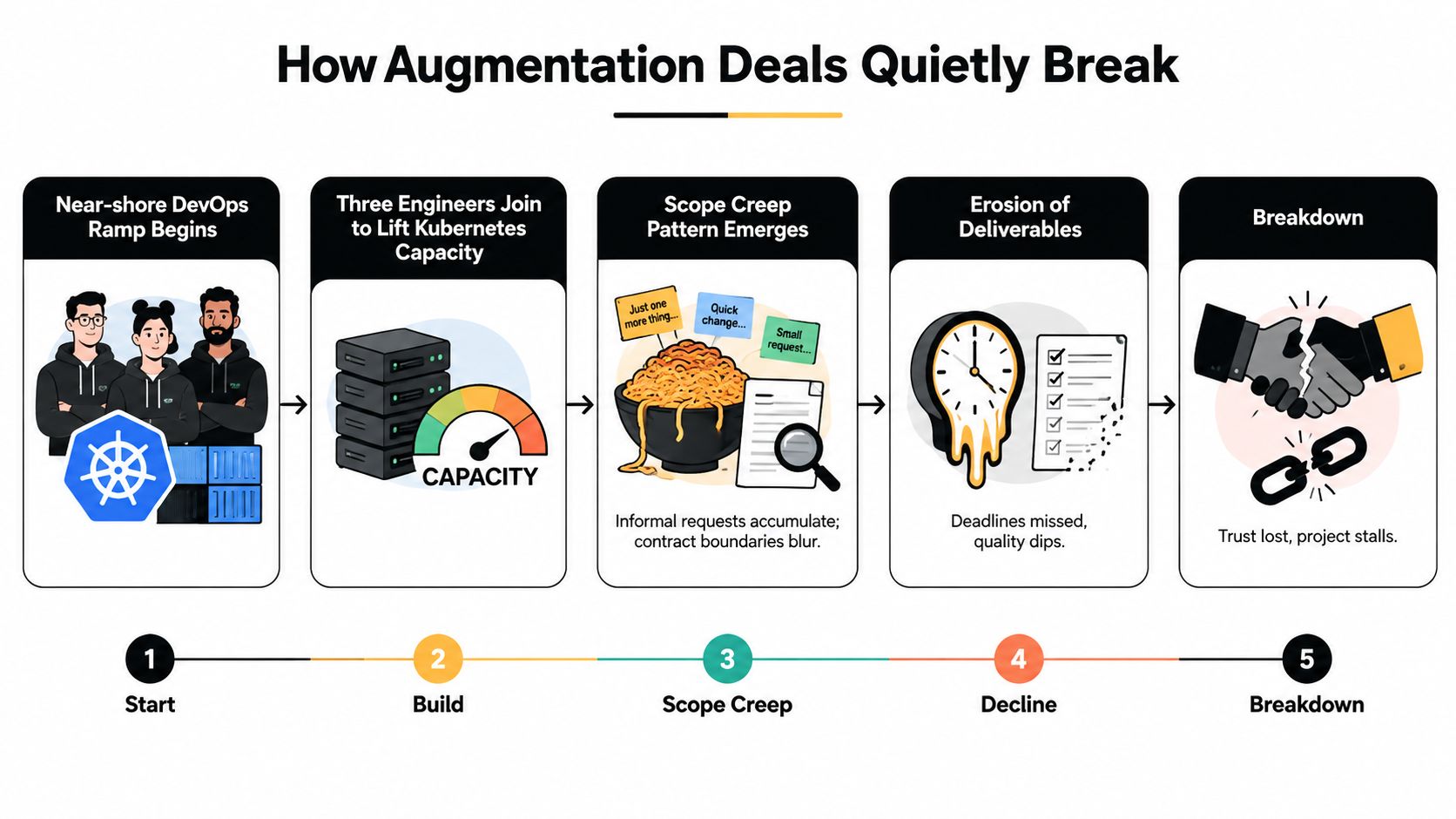
Knowledge control creates a second failure path. Onboarding documents sit in the vendor's Confluence space, while infrastructure runbooks remain in a repository your team cannot administer. Your engineers may be able to replace the provider, but they lack the context needed to operate the platform without disruption. Client-owned repositories, accounts, runbooks, and documentation are contract requirements, not courtesy requests.
A provider may also rotate the strongest engineer. The replacement receives code access but not the reasoning behind the architecture. Without documentation milestones, walkthroughs, and a defined handoff period, delivery slows while your team reconstructs decisions that should have been captured during normal work.
The employment boundary also drifts
Augmented engineers may attend internal meetings and work closely with company employees. The risk starts when they receive company titles, join compensation discussions, or report directly to managers who supervise your employees. Collaboration supports delivery. Your operating model must still preserve the provider's responsibility for payroll, benefits, HR discipline, employment classification, and formal performance administration.
Name the technical managers who may direct day-to-day work, and state which employment decisions remain with the provider. Actual working practices matter, so the contract cannot rely on labels alone.
Each failure has a control:
Scope creep: A written scope ceiling and change-approval process.
Vendor lock-in: Client-owned documentation, repositories, accounts, and runbooks.
Knowledge loss: Required documentation and transition assistance when staff change.
Boundary drift: Clear allocation of technical direction and employment administration.
For the people and process side, solving HR issues in tech adds useful context. Your contract should expose these risks early, before an operational shortcut becomes a switching cost or a compliance problem.
Negotiation Moves That Actually Shift the Terms
Don't negotiate every sentence equally. Spend your advantage on terms that control cost, ownership, security, and exit.
Start with the rate card
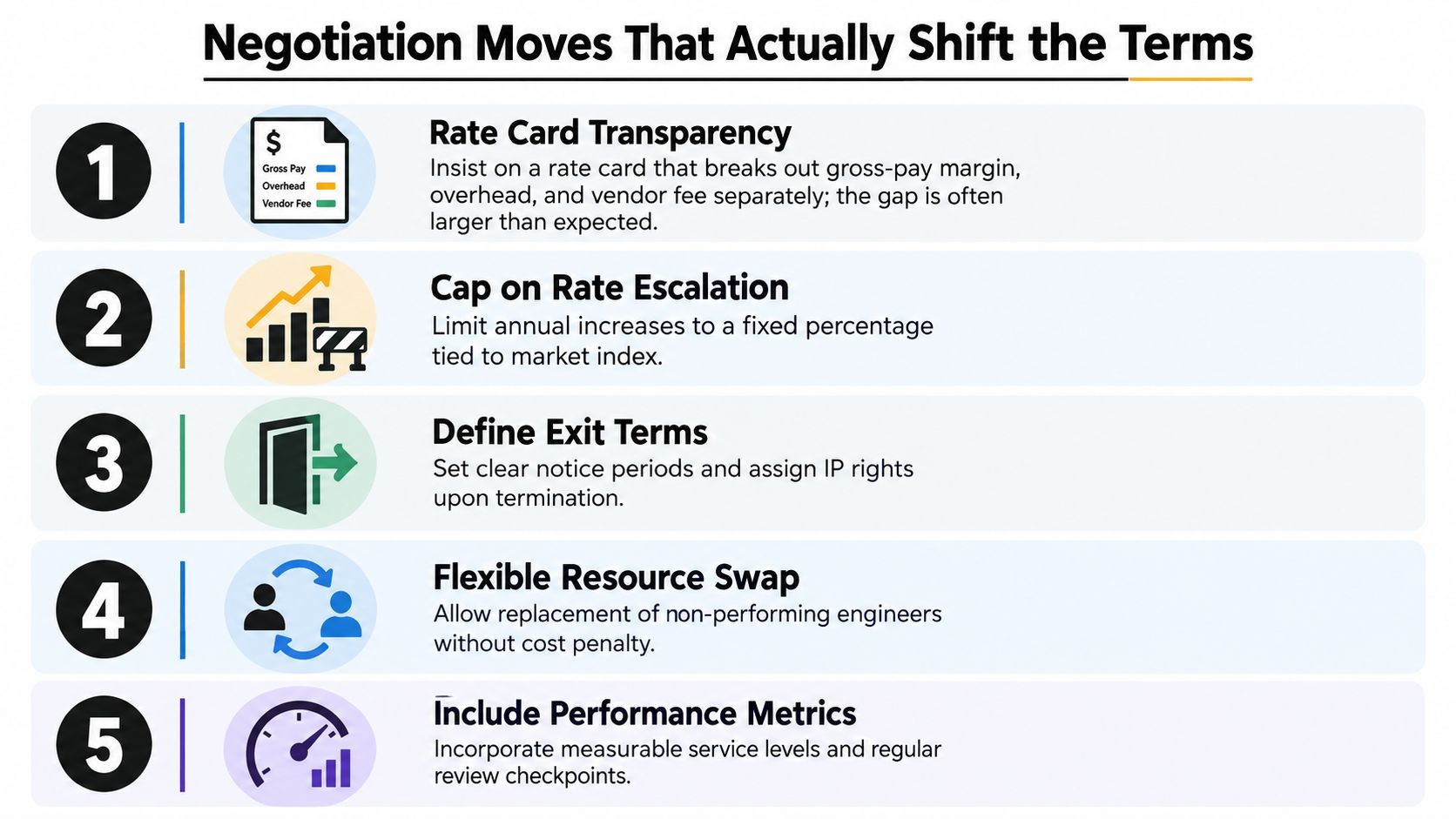
Request a transparent breakdown of gross-pay margin, overhead, and vendor fee. The gap between the engineer's compensation and your billed rate can be 30% to 50%, according to the supplied negotiation guidance, so the commercial structure deserves direct scrutiny. (Staff augmentation risk and mitigation discussion)
Ask whether the rate includes recruiting, HR administration, equipment, benefits, management, and replacement support. Require the provider to identify which costs are pass-through and which are fixed.
Trade price for protection
A rate concession has limited value if the contract still allows weak IP assignment, uncontrolled substitution, or an expensive exit. Trade commercial movement for concrete protections, such as a written replacement guarantee, resource-level termination, documented handoff, audit rights, and a security incident process.
Challenge the liability cap
A cap tied only to fees paid may be inadequate for production systems or sensitive data. Ask for targeted carve-outs covering IP infringement, confidentiality breaches, fraud, and security incidents. The provider may reject unlimited liability, but a risk-weighted structure is more defensible than a blanket cap.
Protect the off-ramp
Don't accept vendor exclusivity without a corresponding audit right and a practical exit window. If your plan may shift from augmentation to direct hiring, managed services, or another provider, define conversion fees and non-solicitation terms before the relationship begins.
Freeze the commercial rules
For a multi-month engagement, lock the rate for an agreed period or define a single adjustment mechanism with advance notice. Don't accept a contract that combines a general index increase with a discretionary “market adjustment.”
Always request the vendor's MSA redlines. Their first draft reveals where they expect to fight, especially around substitution, liability, IP reuse, payment timing, and termination.
Use this negotiation checklist during the call:
Make billing auditable. Define hours, approvals, expenses, overtime, currency, and invoice disputes.
Make ownership immediate. Assign work product as created, subject to clearly documented pre-existing IP.
Make replacement operational. Define qualification, timing, handoff, and whether the replacement costs more.
Make security specific. Name the data, systems, controls, evidence, and notification process.
Make exit usable. Allow removal of an individual resource without terminating the entire agreement.
CTO Checklist and How TekRecruiter Fits
A CTO should be able to identify the dangerous omissions before approving the signature. Run this review against the MSA, SOW, security addendum, and onboarding plan.
Contract clauses
Scope: The SOW names the role, technology, expected work, reporting line, and approval process.
IP: The agreement assigns source code, documentation, architecture, tests, and AI-assisted work to the client.
Confidentiality: The provider and individual engineer have enforceable confidentiality duties.
Data protection: Access, residency, subprocessors, incident response, deletion, and audit evidence are defined.
Liability: Caps and carve-outs match the production and regulatory exposure.
Termination: You can terminate for convenience, remove a specific resource, and receive transition assistance.
Commercial and operational controls
Billing: The rate card explains labor, vendor charges, expenses, overtime, and rate changes.
Approvals: A named client manager approves time and scope changes.
Access: Repository, cloud, ticketing, and production permissions follow least-privilege principles.
Documentation: Runbooks, architecture decisions, tests, and deployment knowledge live in client-controlled systems.
Performance: The parties define response expectations, escalation paths, review checkpoints, and cure periods.
The three clauses people skip under pressure
IP assignment gets deferred because everyone assumes ownership is obvious. It isn't. Contract language must cover pre-existing materials, reusable tools, third-party components, and AI-assisted output.
Knowledge transfer gets treated as a courtesy rather than a deliverable. Require documentation throughout the engagement, not only when a resource is leaving.
Termination for convenience gets softened to protect the vendor's forecast. That creates operational debt. You need a usable off-ramp if priorities, funding, security requirements, or internal hiring plans change.
TekRecruiter structures technology staffing around external engineers joining the client team under client-side technical management. Its offering includes staff augmentation, direct hire, on-demand access to a bench of 30,000+ pre-vetted engineers, and managed services. The model can align with a contract that uses named-account oversight, transparent T&M billing, and a replacement guarantee written into the SOW rather than left in a sales presentation.
That structure fits teams that need scarce software, AI, DevOps, SRE, cloud, data, Salesforce, ERP, or cybersecurity skills while retaining control of the backlog and technical decisions. It isn't the right shape when you want a provider to own an entire product outcome, service desk, or platform operation. In that case, a managed-services or outcome-based agreement may be cleaner.
TekRecruiter helps innovative companies deploy top-tier engineers anywhere through technology staffing, recruiting, AI engineering, and staff augmentation. Visit TekRecruiter to discuss the roles, contract safeguards, and delivery model your engineering organization needs.