Staff Augmentation Vs Managed Services A Strategic Guide
Staff augmentation vs managed services a strategic guide: augmentation runs USD 40–250 per hour, while managed services trade control for SLA-backed outcomes.
The whole staff augmentation vs managed services debate really boils down to one thing: control. Where do you want the responsibility—and the risk—to live?
With staff augmentation, you're embedding external specialists directly into your team. You manage them, you direct their work, you own the outcome. It's about adding headcount without the HR overhead. Managed services is the polar opposite. You're handing over an entire function to a provider and holding them accountable for the results. You give up direct control in exchange for a guaranteed outcome.
In our placements, that single trade-off consistently shapes which model fits best. One number anchors it: bypassing the benefits, payroll taxes, and training that come with a permanent hire typically saves 20–40% of a base salary in the short term — which is exactly why augmentation looks cheaper on a six-month horizon and why that advantage often flips once a function becomes permanent. Any cost comparison of staff augmentation and managed services starts with this distinction between variable hourly spend and fixed-fee accountability.
Choosing Your Ideal IT Outsourcing Model

This decision hits your budget, timeline, and the final quality of your project, and there is no universally "better" model — only a better fit for your goals, your team's management capacity, and your appetite for risk. If you're working in demanding fields like AI development or cloud engineering, it helps to understand the value of using a recruiter who can find the highly specialized talent these projects demand.
Staff Augmentation Vs Managed Services At A Glance
The matrix below captures the core differences teams evaluate when deciding between these models. Read it row by row to see how each dimension shifts depending on whether you keep control or hand it off.
| Key Aspect | Staff Augmentation | Managed Services |
|---|---|---|
| Control | You keep direct, hands-on control over tasks and people. | The provider manages the team to deliver pre-defined outcomes. |
| Responsibility | You own the project outcome and carry all the responsibility. | The provider is accountable for the results defined in the SLA. |
| Integration | External talent becomes a direct part of your existing team. | The team operates as a separate unit focused on service delivery. |
| Focus | Filling specific skill gaps and boosting team capacity. | Outsourcing an entire function or business process from start to finish. |
| Pricing model | Hourly rates, typically USD 40–250/hr depending on seniority and location. | A fixed monthly fee for a defined service, often on a 12–36 month term. |
| Speed to start | Days. Vetted contractors can be deployed in as little as 3 days. | Weeks to months, including discovery, solution design, and knowledge transfer. |
| Skill access | Individual specialists you select, one role at a time. | A full provider team — engineers, tooling, and process — behind the SLA. |
| Accountability | The client owns the outcome; the supplier owns the quality of the person placed. | An SLA-bound provider is contractually accountable for the result. |
| Long-term ownership | You accumulate the knowledge, the IP, and the continuity burden. | The provider owns the delivery lifecycle, tooling, and operational risk. |
Choose staff augmentation if you have strong internal project management and need to extend your own team with specific skills while keeping the outcome in-house. Choose managed services if you want an entire function — cloud operations, security monitoring, support — delivered against an SLA with predictable costs and the risk sitting with the provider. Market data indicates that managed services currently represent the larger share of the combined economy, but staff augmentation remains valuable when the client needs direct control, as outlined in this combined market breakdown.
This table lays it out, but if you want to see how these models stack up against the broader world of outsourcing, check out our guide on staff augmentation vs outsourcing.
The fundamental trade-off is control for accountability. With staff augmentation, you get granular control but own the risk. With managed services, you transfer risk but cede direct operational control to achieve a guaranteed outcome.
Ultimately, the right model is only as good as the partner you choose. If you need to scale your team with elite AI or cloud engineers, TekRecruiter specializes in finding the top 1% of talent—the people who don't just fill a seat, but accelerate your entire project.
Staff Augmentation Or Managed Services: Which Fits Your Team?
Writing down the criteria can reveal the answer and clarify the path forward early.
Choose staff augmentation if:
- You need short-term capacity — a quarterly development sprint, a six-month migration, a launch push — not a permanent function.
- You have a capable internal project manager. In our placements, teams that kept strong internal PM hit deadlines with augmentation; teams without one struggled, no matter how good the contractors were.
- You need direct control over proprietary IP, your codebase, or your security protocols.
- Speed matters more than anything else. We can deploy vetted consultants in as little as 3 days.
Choose managed services if:
- The function is ongoing — cloud operations, 24/7 monitoring, helpdesk — and will still exist in three years.
- You operate in a regulated environment and need a provider contractually bound to security and uptime outcomes.
- You want budget predictability over hour-by-hour flexibility.
- Your internal team is stretched thin and would spend more time managing the work than supervising a partnership.
One more driver worth naming: the talent shortage isn't going away. Both models are responses to that gap, but they solve different parts of it, as the IT outsourcing and managed service analysis explains. Augmentation adds people to your team; managed services removes an entire workload from it.
Breaking Down The Financial And ROI Differences
When you get down to the numbers, staff augmentation and managed services are two completely different beasts. The choice you make here directly impacts your budget, cash flow, and what your return on investment (ROI) looks like down the road. It's critical to understand the financial mechanics of each before you commit.
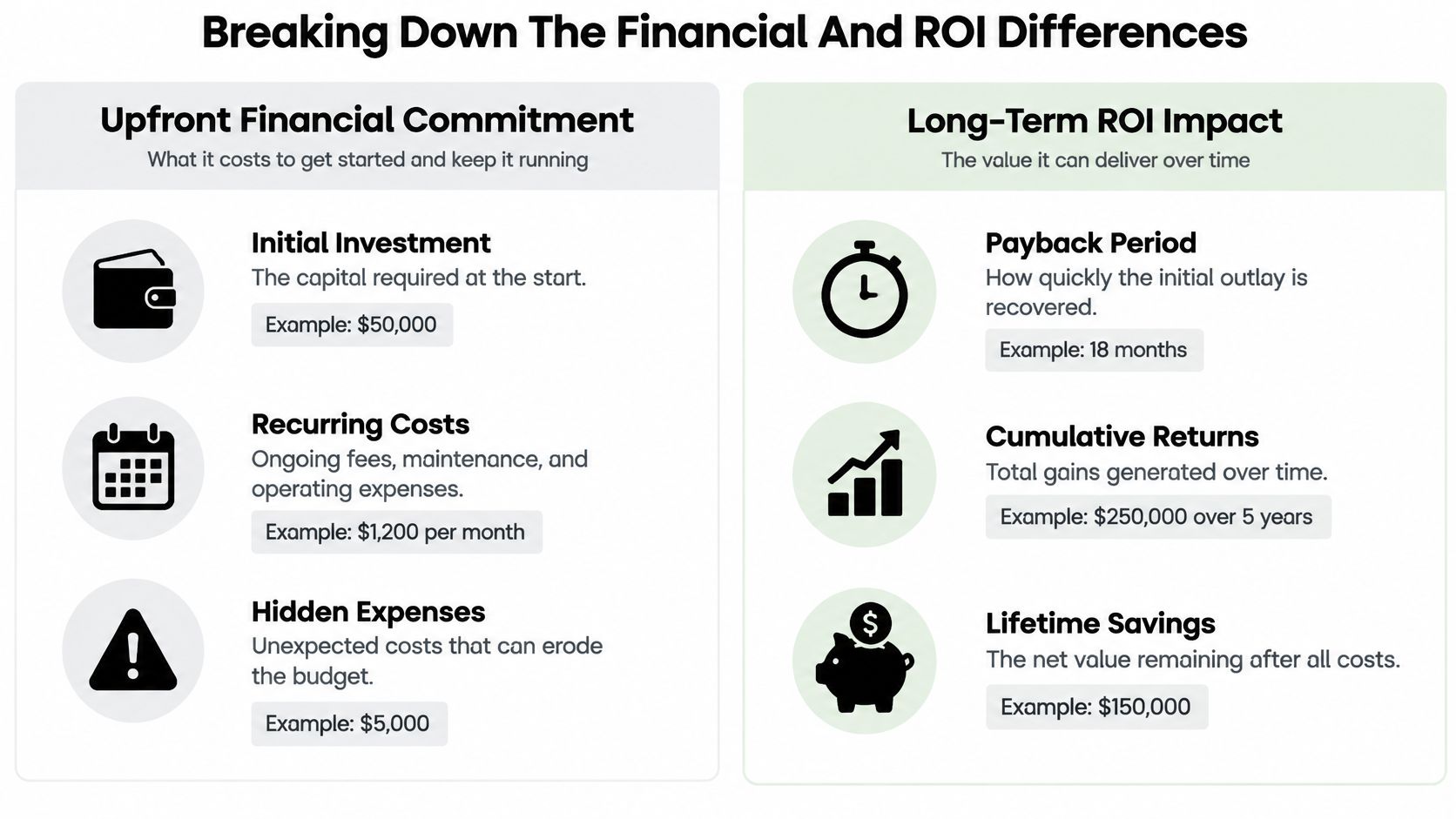
Staff augmentation is all about variable costs. You're billed per person, usually hourly or monthly. This gives you incredible flexibility to dial your spending up or down based on what a project needs at any given moment. You're paying for time and specific expertise—not a guaranteed outcome.
This on-demand model is perfect for projects where the scope might change or when you need to plug a skills gap fast without the financial baggage of a full-time hire.
The Staff Augmentation Cost Model
The biggest financial win with staff augmentation is its straightforward, transparent pricing. You agree on a rate for an engineer, and that's what you pay. No hidden fees, no long-term strings attached. It's a clean way to sidestep the major overhead costs of permanent hires—like benefits, payroll taxes, and training—which can easily tack on an extra 20–40% to a base salary.
Let's look at real-world numbers. For skilled nearshore or offshore software engineers, you might see rates from USD 40–120 per hour. For senior onshore talent, that can jump to USD 100–250+ per hour. Since you only pay for the hours you use, a short-term project of six to twelve months can end up being 10–30% cheaper than building an internal team, once you factor in the time and money spent on hiring and onboarding.
This model shines for targeted, short-burst initiatives. Need to sprint on development for a quarter? Bringing in a cloud specialist for a six-month migration? Augmentation keeps your upfront financial risk to a minimum.
The Managed Services Financial Framework
Managed services flip the script entirely. It's built on a fixed-fee model, typically a predictable monthly or annual contract. Here, the financial focus shifts from inputs (hours) to outputs (results and service levels). You trade the hour-by-hour flexibility for budget predictability and a partner whose profits depend on finding efficiencies.
A managed service provider (MSP) has economies of scale on their side. They've already invested in the specialized tools and optimized processes that allow them to deliver results more cost-effectively than most companies can manage in-house. Over time, those savings get passed on to you.
Managed services contracts often lock clients into 12–36 month terms with predictable payments and Service Level Agreements (SLAs). Case studies show operational cost savings of 15–35% over three-year horizons due to provider efficiencies and tooling.
Staff augmentation costs less for short-term projects, while a managed services contract can lower annualized costs for stable, ongoing work. Predictable expenses and reduced operational overhead often lead to a much higher ROI over 24–36 months. To see how location affects these costs, check out our guide on maximizing cost savings with nearshore software development.
So, what's the right financial model? It all comes down to your time horizon. Staff augmentation is tough to beat for short-term ROI, but managed services deliver superior long-term value for functions that are here to stay.
Whether you need the budget flexibility of staff augmentation or are planning for long-term operational efficiency, the right talent is key. TekRecruiter connects companies with the top 1% of engineers globally, ensuring you have the elite skills needed to drive results, no matter which model you choose.
Comparing Control, Governance, And Delivery Ownership
The debate between staff augmentation and managed services really comes down to one key question: who's in the driver's seat? The answer shapes everything, from your project's governance and day-to-day operations to who's ultimately on the hook if things go sideways.
With staff augmentation, the answer is simple: you are. Your company keeps complete control. Think of augmented team members as temporary pros who plug directly into your existing command structure. They report to your managers, follow your workflows, and become part of your team.
You're the one directing their daily tasks, setting priorities, and steering the project. This gives you total visibility and hands-on governance over every moving part.
The Staff Augmentation Governance Model
Under a staff augmentation model, your company shoulders the full responsibility for the project's success. The provider's job is to find and place skilled talent, but they aren't responsible for how you manage that talent or the results they produce.
This setup is perfect for organizations with strong, established project management practices and clear internal leadership. It lets you scale your team on demand while keeping all decision-making authority exactly where you want it: in-house.
- Direct Management: Your project managers and team leads are in charge of the day-to-day activities of your augmented staff.
- Process Adherence: Augmented professionals adapt to your company's existing tools, methodologies (like Agile or Scrum), and communication channels.
- Outcome Responsibility: Your internal team is the only one accountable for hitting deadlines, staying on budget, and the quality of the final product.
That high level of control means you can pivot fast and make sure the work aligns perfectly with your vision. But it also means you've got no one else to point to if the project veers off course. The distinction is a bit like the one between different employment types, which we break down in our guide on direct hire vs contract employees.
Managed Services And The Shift In Ownership
Managed services completely flips the script. It shifts both control and accountability over to the provider. Instead of just giving you people, a managed services provider (MSP) delivers a specific, pre-defined outcome. You stop managing individuals and start managing a partnership governed by a contract.
With managed services, you trade direct operational control for contractual accountability. The provider is now responsible for delivering results, and their performance is measured against strict, predefined Service Level Agreements (SLAs).
This change in governance is massive. The MSP owns the entire service delivery lifecycle—from managing their own team and processes to investing in the necessary tools and tech. Your role transforms from a hands-on manager to a strategic overseer, making sure the provider hits the agreed-upon Key Performance Indicators (KPIs).
To make this crystal clear, let's use a cloud infrastructure project as an example.
- Staff Augmentation Scenario: You hire three DevOps engineers to join your team. Your Head of Engineering directs their work, assigning them tasks to configure and deploy resources. If a deployment fails, your internal team is on the hook to troubleshoot and fix it.
- Managed Services Scenario: You sign an SLA with an MSP for "99.95% cloud infrastructure uptime." The MSP manages their own team of engineers to hit that target. If a server goes down, it's the provider's contractual obligation to resolve it within a specific timeframe—not yours.
Who owns what can get complicated, so here's a quick breakdown of where the responsibilities lie in each model.
Operational Control And Responsibility Matrix
| Responsibility Area | Staff Augmentation Ownership | Managed Services Ownership |
|---|---|---|
| Daily Task Management | Client: Your managers assign and track all tasks. | Provider: The MSP manages its own team's tasks. |
| Project Direction | Client: You define the strategy and roadmap. | Client & Provider: You set the goals, they define the "how." |
| Team Management | Client: You handle performance, onboarding, and workflow. | Provider: The MSP handles all HR and team management. |
| Process & Methodology | Client: New hires adopt your existing processes (e.g., Agile). | Provider: The MSP uses their own optimized processes. |
| Tools & Technology | Client: You provide and pay for all necessary tools. | Provider: The MSP brings their own tools and tech stack. |
| Quality Assurance | Client: Your internal team is responsible for QA and testing. | Provider: The MSP is contractually obligated to meet quality standards. |
| Final Delivery & Outcome | Client: You are 100% accountable for the final result. | Provider: The MSP is accountable for delivering the agreed-upon outcome. |
| Risk Management | Client: All project-related risks (budget, timeline) are yours. | Provider: The MSP assumes operational and delivery risk. |
This comparison really highlights the core trade-off. While you give up granular control in a managed services model, you gain a partner who is contractually bound to deliver specific, measurable results. This reduces your internal management burden and offloads significant operational risk.
Deciding which model fits your needs is a critical first step. If keeping absolute control is your priority, staff augmentation is the way to go. TekRecruiter can help you find the top 1% of engineers who can work inside your team and execute your vision with precision.
Evaluating Risk, Security, And Business Continuity
When the conversation shifts to risk, the differences between staff augmentation and managed services become razor-sharp. Each model presents a totally different profile for security liability, operational stability, and business continuity. The path you choose determines whether your organization holds onto full responsibility or hands it off to a partner who is contractually bound to deliver.
With staff augmentation, the security and continuity buck stops with you. You're hiring individuals, not an outcome. This means your internal teams are on the hook for every security protocol, threat monitoring alert, and disaster recovery plan. The augmented staff operate within your existing framework, inheriting all its strengths—and all its weaknesses.
This model puts a heavy burden on your internal governance. If a contractor mishandles sensitive data or a project grinds to a halt because they leave unexpectedly, the liability and the operational headache are 100% yours.
The Staff Augmentation Risk Profile
The biggest risks in staff augmentation come down to continuity and knowledge transfer. Contractors are temporary, which creates an inherent risk of critical knowledge walking out the door when their contracts end. This can trap you in a cycle of re-training and project delays, which is both expensive and inefficient.
Plan for continuity from the first week, with documentation, pairing and handoff standards, especially for critical or long-term initiatives. You get high operational control, but you also absorb every single continuity risk.
The Managed Services Approach to Risk Mitigation
Managed services are built from the ground up to transfer and mitigate risk. When you sign a contract with a Managed Service Provider (MSP), you're not just outsourcing the work—you're outsourcing the responsibility for its security and uptime. This is all formalized through Service Level Agreements (SLAs) that legally bind the provider to hit specific performance targets.
MSPs invest heavily in security infrastructure and expert personnel, offering a level of protection most businesses could never afford to build on their own. Their entire business model depends on their ability to deliver secure, reliable outcomes. This fundamental shift—from hiring individuals to procuring a guaranteed service—is the core difference in risk management.
In managed services, risk is transferred, not just shared. The provider is contractually obligated to meet security and uptime SLAs, making them accountable for business continuity and security posture in a way that augmented staff are not.
This transfer of risk leads to measurable security improvements. For instance, companies using MSPs for security operations often see their incident response times drop by 30–50%. They also report a 20–40% improvement in critical tasks like patch cadence, which drastically reduces their vulnerability to known threats. These numbers highlight the key trade-off: you give up some direct control in exchange for a quantifiable reduction in operational and security risk.
Of course, technical safeguards are just one piece of the puzzle. Understanding how SOC 2 certification can unlock business opportunities is vital for any company that wants to build a reputation on a strong security posture. A huge part of that strategy is ensuring your identity and access management is rock-solid; learn more about protecting your digital front door in our guide to Cybersecurity and Okta.
Ultimately, the decision comes down to your company's risk tolerance and in-house capabilities. If your team already has elite security expertise and established continuity plans, the direct control of staff augmentation might be a calculated risk worth taking. But for companies looking to offload liability and get guaranteed uptime, the managed services model is a powerful solution.
Real World Scenarios: When To Choose Each Model
Theory is great, but the practical test in the staff augmentation vs. managed services debate comes down to solving actual business problems. Picking the right model means delivering value, not creating new headaches. The choice hinges entirely on your goals, your resources, and how much control you need to keep.
Over the last decade, a massive chunk of IT spending has shifted to outsourced delivery. We're talking about a global market that hit approximately USD 520–550 billion annually in the early 2020s. This isn't a single trend; the market has split into two distinct dynamics: managed services for long-term operational ownership and staff augmentation for flexible, on-demand skills. You can get a deeper look at these spending drivers in this detailed market analysis.
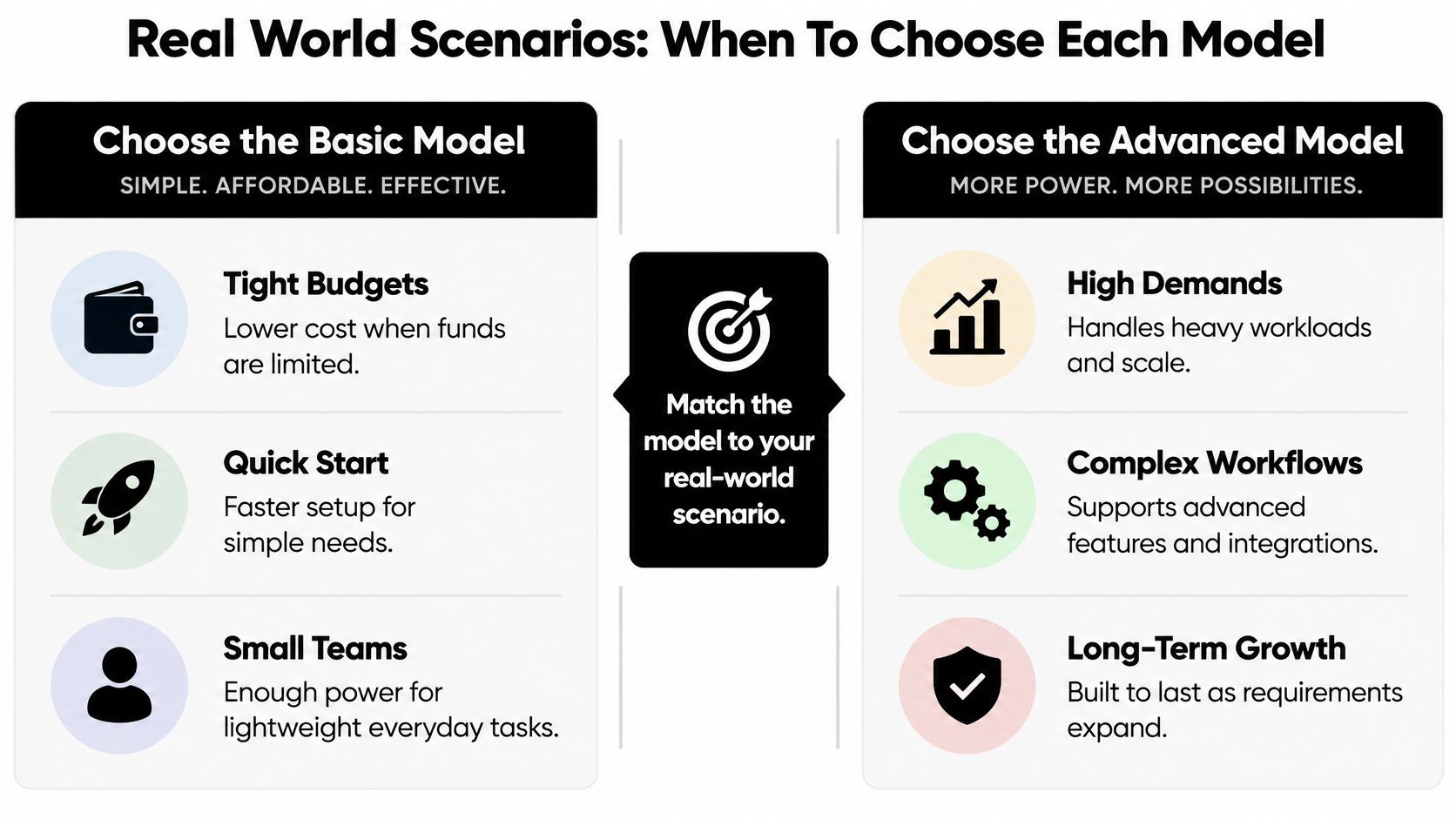
This decision tree cuts right to the chase. If direct control over the process is essential, staff augmentation is your path. If you need guaranteed outcomes and want to hand off the risk, managed services is the clear winner.
This visual simplifies the core trade-off. It's about aligning the model with your governance style and operational reality.
Let's break it down with some concrete examples.
When To Choose Staff Augmentation
Staff augmentation is your go-to when you need to inject specific talent into your existing team without handing over the project keys. It's about adding firepower, not outsourcing strategy.
Scenario 1: Accelerating A Critical Project Phase
- The Situation: Your team is building a new AI analytics platform. You're on track, but the final six-month push requires two senior Python developers with deep NLP experience to hit the launch date.
- Why It Fits: You already have strong project management and a locked-in roadmap. Staff aug lets you bring in the exact expertise needed to cross the finish line faster, without messing with your team structure or adding permanent headcount.
Scenario 2: Filling A Niche Skill Gap
- The Situation: You're migrating legacy infrastructure to Google Cloud Platform (GCP). Your team knows AWS and Azure inside and out but lacks a certified GCP architect to nail the initial setup and security configuration.
- Why It Fits: Hiring a full-time GCP expert for a one-time migration makes no sense. Augmentation provides temporary, high-impact talent to bridge that critical gap, and your internal team gets to learn from them in the process.
Scenario 3: Maintaining Control Over Proprietary IP
- The Situation: A fintech startup is building a proprietary trading algorithm. The core IP is everything—their most valuable asset—and they need absolute control over the code and the entire development process.
- Why It Fits: With staff augmentation, the engineers work under your direct management, on your systems, and follow your security protocols. All intellectual property stays securely in-house. This level of control supports deep-tech innovation.
When To Choose Managed Services
Managed services are the answer when you need to offload an entire function to a partner who can own the outcome and manage the risk. You're buying a result, not just renting an expert.
Scenario 1: Outsourcing 24/7 Cloud Infrastructure Monitoring
- The Situation: An e-commerce platform needs 99.99% uptime, especially during peak season. Building an in-house, 24/7 network operations center (NOC) is way too expensive.
- Why It Fits: A managed service provider delivers a complete, SLA-backed monitoring solution. They bring the tools, the processes, and a global team to ensure constant coverage. Your internal team can focus on building features, not firefighting server alerts at 3 AM.
Scenario 2: Managing A Complete Cybersecurity Operations Center (SOC)
- The Situation: A healthcare provider has to comply with strict data protection regulations. They need advanced threat detection and incident response but can't find or afford the specialized cybersecurity talent to run a SOC internally.
- Why It Fits: A managed security service provider (MSSP) delivers a full-fledged SOC as a service. They take full responsibility for security outcomes, backed by SLAs, which slashes your risk and ensures certified experts are protecting sensitive patient data.
The core difference is focus. Staff augmentation is about doing the work under your direction. Managed services are about owning the outcome and delivering a predefined result.
Choosing the right model is the first step. Finding the right people or provider is the next. If a managed service fits, we can find the best managed service provider for that function, and you contract with them directly. If staff augmentation is the path for your next project, TekRecruiter specializes in finding the top 1% of engineers anywhere in the world, vetted for the skills your projects require and ready to work inside your team.
Common Questions, Answered
When you're weighing staff augmentation against managed services, the theoretical differences are one thing. But how these models work in practice matters most. Let's tackle some of the most frequent questions that come up.
What is a staff augmentation arrangement?
It's a contract where vetted external engineers join your existing team on a temporary or project basis and work under your management, not the supplier's. You direct their tasks, they follow your processes, and you keep the outcome. At TekRecruiter, consultants are interviewed by the client before they start, so you know exactly who you're adding before day one.
What is the difference between managed services and professional services?
Professional services are project-based and end at delivery — think a consulting engagement, an implementation, or a one-off audit with a defined scope and deliverable. Managed services are ongoing: the provider runs a function indefinitely against an SLA, whether that's uptime, patch cadence, or response times. A useful shorthand is that professional services hand you a finished thing, while managed services keep the thing running.
What is an example of a managed service provider?
IBM, Accenture, and Rackspace are classic examples — Rackspace, for instance, manages cloud infrastructure and operations for companies that don't want to run it themselves. A managed cloud offering of the kind Cleffex Digital ltd describes is representative of the category. The market behind these providers is enormous: one 2025 estimate projects USD 731.08 billion in global managed-services revenue by 2030, growing at 14.1% annually, per Grand View Research.
Can I Switch From Staff Augmentation To A Managed Service?
Yes, and frankly, it's a pretty smart way to do it. Lots of companies dip their toes in the water with staff augmentation to plug an immediate skills gap or just get a project moving faster. This gives the provider a front-row seat to your business—they learn your code, your culture, and your quirks firsthand.
Once that trust and understanding are there, shifting to a managed service becomes a natural next step. A good partner will use that insider knowledge to map out a clear scope of work and solid Service Level Agreements (SLAs), making the transition feel less like a handover and more like an evolution. The goal is zero disruption.
How Is Intellectual Property Handled In Each Model?
This is a huge one, and the difference couldn't be starker.
With staff augmentation, your company almost always keeps 100% ownership of the intellectual property (IP). Think of it this way: the engineers are an extension of your team, working under your direction on your projects. The IP remains yours.
This makes staff augmentation the only real choice if you're building proprietary algorithms, core platform features, or anything that gives you a competitive edge.
Managed services is a different story. IP ownership is a major negotiation point and has to be spelled out in the contract. You'll own the final deliverables, sure, but the provider often hangs on to the rights for their own frameworks, tools, and processes they used to build it. Get this clarified in writing before you sign anything.
With staff augmentation, you own the IP because you own the process. With managed services, you own the deliverable, but the provider often owns the tools and methods used to create it. Clarifying this in the contract is non-negotiable.
What Is The Onboarding Time For Each Model?
Staff augmentation is all about speed. You're adding a skilled person to a team and process that already exists. A new engineer can plug into your workflow and be contributing in just a few days. You're not building a new system, just adding horsepower to the one you have.
Onboarding for a managed service is a much more deliberate affair, often taking several weeks or even a couple of months. It's a structured process for a reason:
- Discovery Phase: The provider has to get under the hood of your systems and requirements.
- Solution Design: They map out exactly how they'll deliver the service.
- Knowledge Transfer: Your team formally hands over the necessary information.
- Implementation: The provider rolls out their tools and takes the controls.
This methodical setup is what allows the provider to confidently take ownership and hit their SLAs from day one.
Deciding between staff augmentation vs managed services really comes down to what you need most: control, speed, or ownership.
 Ron SmithPresident & Lead RecruiterTekRecruiter